
Why dishwasher pumps fail: causes, symptoms, and fixes
2026-07-23 23:53:23
Dishwasher pumps fail primarily due to mechanical blockage, electrical motor faults, or seal deterioration, and the underlying cause determines whether a clean and descale will restore function or whether replacement is necessary. The most telling symptoms are standing water in the tub after a cycle, a humming or grinding noise during drainage, or complete silence when the drain phase should be audible. Hard water mineral buildup and food debris reaching the impeller are the two most frequent contributing factors, accelerating wear well beyond normal expectations. Pump lifespan averages several years, typically under a decade, though heavy daily use or neglected maintenance can shorten that considerably.
Key failure indicators at a glance:
- Standing water remaining after a full cycle
- Humming or grinding noises during the wash or drain phase
- No water movement despite an audible motor
- Dishes emerging dirty or still soapy
- Water pooling on the floor beneath the appliance
- Complete silence during the drain cycle, suggesting a control board or wiring fault rather than the pump itself
How does a dishwasher pump actually work?
Every dishwasher relies on two distinct pump systems working in sequence. The circulation pump draws water from the sump and forces it through the spray arms under pressure during the wash cycle, whereas the drain pump activates at the end of each cycle to expel used water through the drain hose. Both pumps share a common architecture: an electric motor drives an impeller, a small rotating blade assembly, which moves water by centrifugal force.
The impeller and motor are the components most vulnerable to wear. When the impeller spins freely and the motor windings are intact, water circulates and drains as intended. When either element is compromised, the consequences are immediate and obvious: dishes remain dirty, water pools at the bottom, or the appliance stops mid-cycle.
Proper pump function also depends on the sump area remaining clear of debris, the drain hose being correctly routed to prevent backflow, and the seals between the motor housing and pump body remaining watertight. A failure in any one of these areas can mimic a dead pump even when the motor itself is perfectly functional.
- Circulation pump: runs during the wash and rinse phases, drives water pressure through spray arms
- Drain pump: activates at cycle end to remove dirty water via the drain hose
- Impeller: the rotating blade component inside each pump that moves water
- Motor windings: the electrical coils that power the impeller; vulnerable to water ingress and overheating
- Pump seals: prevent water from entering the motor housing; typically last several years with normal use
What causes a dishwasher pump to fail?
Several distinct failure mechanisms account for the majority of pump problems, and understanding which one applies determines the correct course of action.
Mechanical blockage is the most common cause. Food debris, broken glass, fruit stones, and small utensil fragments can pass through the filter and reach the impeller housing. A single glass shard caught in the impeller can jam it mid-cycle, forcing the motor to strain against the resistance until it overheats. The drain pump is particularly susceptible because it handles all the waste water expelled from the tub.
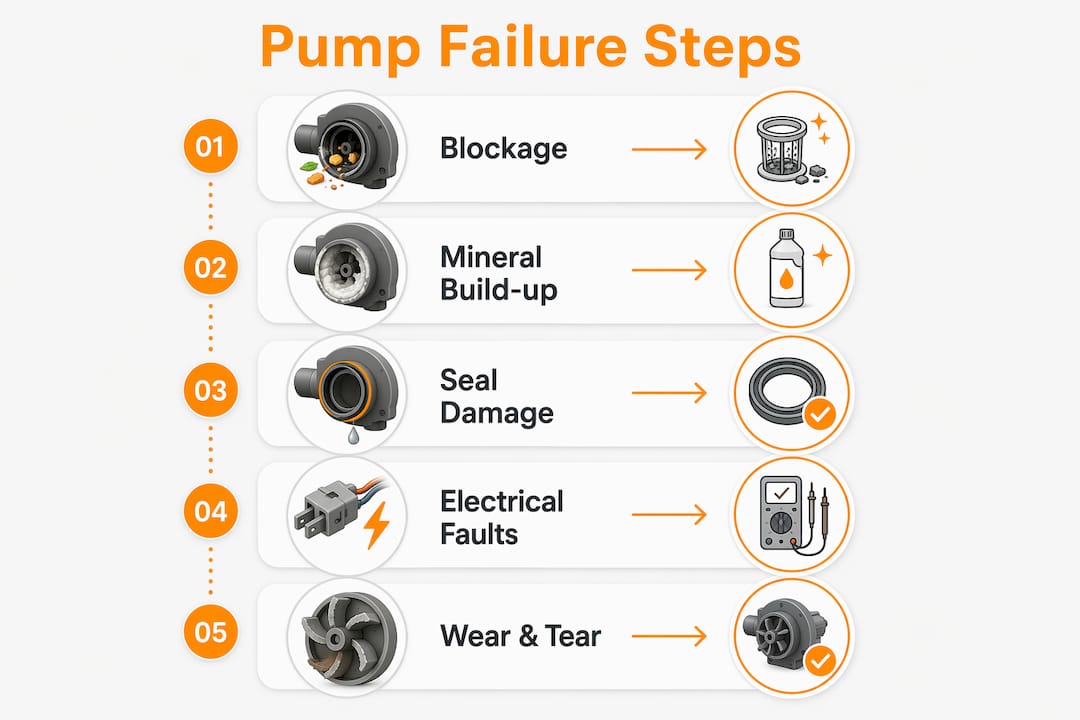
Hard water mineral buildup is the leading cause of premature pump failure in areas with water hardness elevated. Calcium and magnesium deposits coat the impeller blades and motor bearings with each cycle, gradually increasing friction. The motor draws more current to compensate, bearings wear faster, and seals crack prematurely than they would in a soft-water household. Central European water supplies vary considerably in hardness, and homeowners in limestone-heavy regions face this risk acutely.
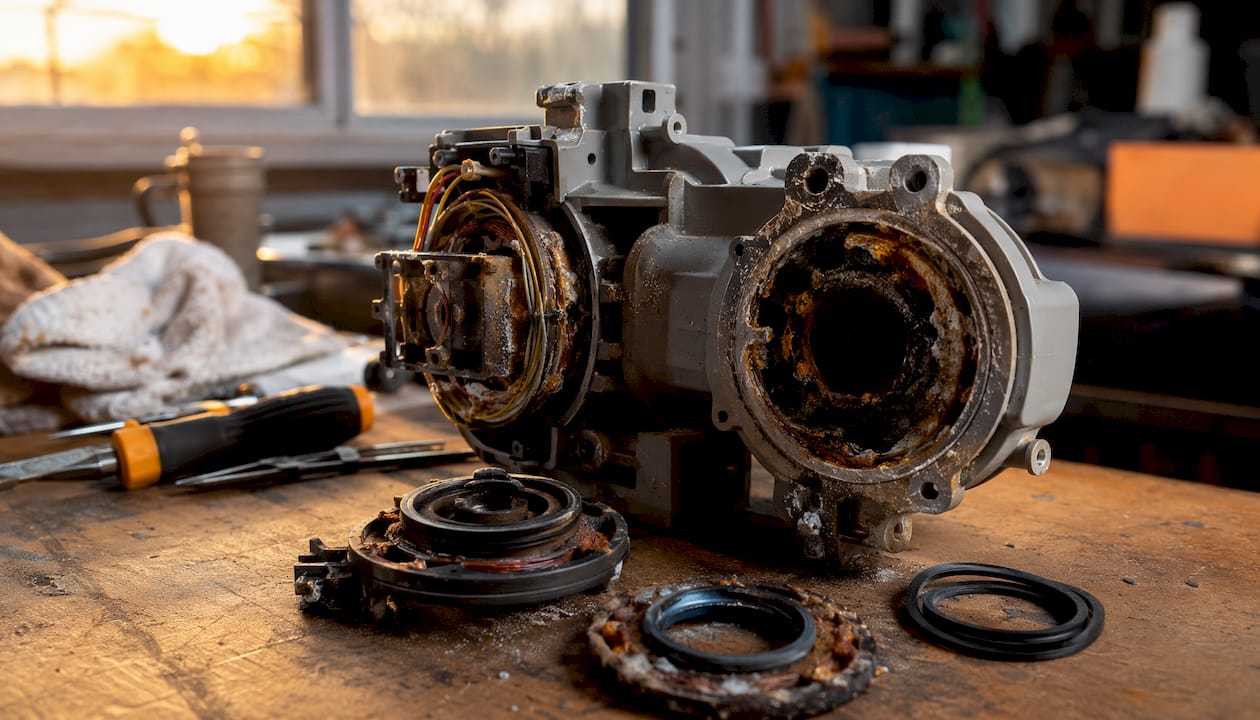
Seal deterioration allows water to seep into the motor windings, causing electrical shorts and corrosion. This failure mode is insidious because it develops gradually; a minor weep around the motor housing can go unnoticed for weeks before the motor fails outright.
Electrical faults including burned motor windings and failed start capacitors account for a smaller but significant proportion of failures. A motor that hums but will not spin often has a failed capacitor rather than a dead winding, which is a considerably cheaper repair. Power surges and sustained overheating from debris jams are the primary triggers for winding burnout.
Age and accumulated wear eventually affect every pump regardless of maintenance. Bearings degrade, plastic components crack, and the assembly reaches the end of its serviceable life. Pumps in dishwashers running more than one cycle per day tend to reach this point at the lower end of the 7–12 year range.
How to recognise the signs of a failing pump
Identifying the correct symptom early can prevent a minor fault from becoming a full motor replacement.
Standing water is the clearest sign of drain pump failure. After a complete cycle, the tub floor should be dry or nearly so. Consistent pooling of an inch or more of cloudy water indicates the drain pump cannot generate sufficient pressure to expel it, or has stopped working entirely. Before concluding the pump has failed, check the filter and drain hose for blockages, as these can produce identical symptoms.
Unusual noises are among the most reliable early indicators. A healthy pump produces a steady, low hum. Grinding typically means a foreign object is caught in the impeller. A high-pitched hum with no water movement suggests the motor is receiving power but the impeller is seized, often from heavy mineral buildup. Clicking or rattling points to loose debris circulating through the housing before it causes a full jam. Progressive failure often begins as a quiet hum that worsens to grinding over several weeks, signalling bearing wear that early intervention can still address.

Poor cleaning performance with dishes emerging dirty or soapy despite a full cycle points to circulation pump weakness. Reduced impeller efficiency lowers water pressure through the spray arms, and items on the top rack, which depend most on good pressure, are usually the first to show the effect.
Water leaks beneath the appliance can originate from a cracked pump housing or worn seals rather than the door gasket. Moisture or rust marks on the floor directly under the machine, rather than at the front, suggest the pump assembly is the source.
Complete silence during the drain phase is a distinct symptom worth treating separately. A silent dishwasher at drain time usually implicates a control board or wiring fault rather than the pump itself, because a dead pump motor typically still produces a hum as it receives power.
How to diagnose dishwasher pump problems step by step
Accurate diagnosis before ordering parts saves both time and money. Many faults that present as pump failure originate elsewhere in the appliance.
Tools required: a multimeter, a set of screwdrivers (flathead and Phillips), a torch, and protective gloves. A shallow tray or towels are useful for catching residual water.
- Disconnect power. Unplug the dishwasher or switch off the circuit breaker before any inspection. Never work on a live appliance.
- Check the filter and sump area. Remove the lower spray arm and filter assembly. Inspect the sump for visible debris, glass fragments, or accumulated scale. Clear anything present before proceeding.
- Inspect the drain hose. Confirm the hose is not kinked, blocked, or incorrectly routed. A high-loop installation or air gap device is required to prevent backflow from the sink drain. A blocked or siphoning hose produces standing water that looks identical to pump failure.
- Listen during a test cycle. Restore power briefly and run a short cycle. Note whether the pump hums during the drain phase. A hum without water movement points to a mechanical jam or seized bearing. Silence points to an upstream electrical fault.
- Test motor resistance with a multimeter. Access the pump connector and measure resistance across the motor terminals. A healthy motor winding reads within the normal range; an open circuit reading confirms a burned winding, while a near-zero reading indicates an internal short. Both require pump replacement.
- Check for voltage at the pump terminals. If the motor shows healthy resistance but the pump does not run, test for voltage at the connector during the drain phase. No voltage confirms the fault lies with the control board, wiring harness, or thermal fuse rather than the pump itself.
Pro Tip: A humming pump with no water movement almost always means a mechanical jam or seized bearing, not a dead motor. Try spinning the impeller by hand through the sump opening before condemning the pump. If it turns freely, the capacitor is the more likely culprit on models that use one.
How to clean and unblock a dishwasher pump safely
Cleaning resolves a substantial proportion of pump problems without any replacement parts. Blockages and mineral scale are both addressable with the right approach.
Accessing the pump area:
- Disconnect power and remove the lower rack.
- Unscrew and lift out the spray arm, then remove the filter basket and coarse filter.
- With a torch, inspect the sump cavity beneath the filter for debris. Use gloves to remove any glass fragments, food matter, or foreign objects by hand.
- If the impeller is accessible, attempt to rotate it gently. Resistance or grinding under finger pressure confirms a jam or scale seizure.
Removing debris and descaling:
- Clear visible blockages from the impeller housing using long-nose pliers or tweezers for glass or bone fragments.
- For mineral scale, pour a citric acid-based dishwasher cleaner into the base of the empty tub and run a hot cycle. Commercial descaling products designed for dishwashers are widely available across Central Europe and dissolve calcium deposits effectively.
- Descaling every 3–6 months in hard water areas significantly reduces impeller seizures caused by scale accumulation.
- Clean the spray arm nozzles quarterly using a toothpick or fine wire to clear blocked holes. Clogged nozzles reduce water flow and force the pump to work harder, accelerating wear.
Checking seals and gaskets during cleaning:
Whilst the pump area is accessible, inspect the rubber gasket between the pump body and motor housing for cracking or compression damage. A worn gasket is inexpensive to replace and prevents the water ingress that leads to motor failure.
Pro Tip: Scraping plates thoroughly before loading is one of the most effective ways to protect the pump. Rice grains, olive stones, and small bone fragments pass through filters and reach the impeller with surprising ease. A monthly filter clean combined with a quarterly descale keeps the pump running at full efficiency.
How to test whether your dishwasher pump is functioning correctly
Electrical and mechanical tests together give a definitive picture of pump health and distinguish genuine pump failure from wiring or control board faults.
Electrical tests:
- Disconnect the pump connector and set the multimeter to resistance mode.
- Measure across the motor terminals. A reading within the healthy range confirms the windings are intact. An open circuit or a near-zero reading confirms motor failure.
- Test between each terminal and the motor casing. Any continuity here indicates failed motor insulation and confirms replacement is necessary.
- On models fitted with a start capacitor, test the capacitor separately. A failed capacitor produces the characteristic symptom of a motor that hums but will not spin, and replacing it is far less costly than a full pump assembly.
- Restore power and measure voltage at the pump connector during the drain phase. Correct voltage with a failed motor confirms the pump is at fault. No voltage points to the control board, thermal fuse, or wiring harness.
Mechanical tests:
- With power disconnected, reach into the sump and attempt to rotate the impeller by hand. Free rotation with no resistance suggests the pump is not mechanically jammed; stiff or immovable rotation confirms a seizure from scale or debris.
- Listen for bearing noise when spinning the impeller manually. A gritty or grinding sensation under finger pressure indicates worn bearings that will worsen progressively.
Differentiating pump failure from other faults:
- Motor hums, no water movement: mechanical jam, seized bearing, or failed capacitor
- Motor silent, no water movement: upstream electrical fault (control board, wiring, fuse)
- Motor runs, water does not drain: blocked drain hose or check valve rather than pump failure
- Motor runs, dishes remain dirty: circulation pump impeller worn or broken, not drain pump
Dishwasher pump replacement: when and how to approach it
Cleaning and electrical testing will confirm when a pump is beyond recovery and replacement is the only remaining option.
Indicators that replacement is necessary:
- Multimeter confirms open circuit or internal short in motor windings
- Impeller is physically cracked or broken
- Pump housing is cracked and leaking
- Repeated seizures despite thorough descaling, indicating irreversible bearing wear
- Repair costs become a significant fraction of the cost of a new appliance, at which point replacement of the dishwasher itself is generally the sounder financial decision
Cost considerations:
Common pump repairs cost a moderate amount including parts and labour including parts and labour, depending on the model and region. For older appliances or premium brands with discontinued parts, sourcing costs rise. A professional diagnosis before committing to repair avoids the scenario of replacing a functioning pump when the actual fault lies with the control board or wiring.
Replacement procedure overview:
- Disconnect power and water supply. Pull the dishwasher clear of the cabinetry if necessary to access the base.
- Remove the lower rack, spray arm, and filter assembly to access the sump.
- Place towels beneath the appliance and disconnect the drain hose and pump inlet hose, noting their orientation.
- Disconnect the pump electrical connector.
- Unscrew or unclip the pump assembly from the sump housing, rotating it to release locking tabs where present.
- Fit the new pump with a fresh seal or gasket. Never reuse the old gasket; it takes a permanent compression set and will leak.
- Reconnect all hoses and the electrical connector, then run a full cycle whilst checking every hose clamp for drips before pushing the appliance back into the cabinetry.
Pump assemblies vary considerably by brand and model, so confirming the correct part number before ordering is necessary. Disposal of the old pump should follow local electrical waste recycling guidelines, as the motor contains copper windings and electronic components.
When should you call a professional appliance repair service?
Some dishwasher pump faults are well within the reach of a competent homeowner with basic tools. Others carry a genuine risk of water damage, electrical injury, or misdiagnosis that makes professional involvement the more prudent choice.
Calling a technician is advisable when:
- Electrical diagnostics go beyond a basic multimeter test, particularly where control board faults are suspected
- The pump replacement requires removing the appliance from fitted cabinetry, which risks damaging surrounding units or flooring
- Pump faults persist after cleaning, descaling, and basic electrical checks
- The appliance is under warranty or subject to a manufacturer recall, where DIY work may void coverage
- A burning smell or visible scorch marks are present, indicating a more serious electrical fault
- Water damage to the surrounding cabinetry or flooring has already occurred and the source has not been conclusively identified
A professional appliance repair service also brings model-specific knowledge that is difficult to replicate from general guidance. Certain brands have known pump failure patterns or service bulletins that alter the diagnostic approach. Misidentifying a control board fault as a pump failure and replacing the pump unnecessarily is a common and costly mistake; professional diagnosis avoids it. Elserve provides quality appliance repairs across London, with two-hour time slots that minimise disruption when a fault requires expert attention.
Expert insights on protecting dishwasher pumps from premature failure
The most consistent finding from appliance technicians is that the majority of premature pump failures are preventable. Hard water mineral buildup is the single largest contributing factor, and annual descaling in hard water areas is the most cost-effective maintenance step a homeowner can take. In regions where water hardness exceeds 7–10 grains per gallon, a quarterly descaling schedule is preferable to an annual one.
Early intervention on noise symptoms pays dividends. Technicians consistently advise that a pump producing a progressive hum that worsens to grinding over weeks is signalling bearing wear that cleaning can still address. Ignoring that warning and waiting for complete failure typically converts a £30 descaling job into a £90–£150 pump replacement. The same logic applies to filter maintenance: a blocked filter forces the pump to work harder on every cycle, compounding wear incrementally.
The repair-versus-replace calculation deserves honest consideration when a pump does fail. For a dishwasher more than ten years old, a pump replacement costing close to the 50% threshold of a new appliance cost is rarely a sound investment, particularly if other components are approaching the end of their service life. Professional diagnostic assessment before committing to repair expenditure is advisable precisely because many faults that present as pump failures originate in cheaper components such as the check valve, drain hose, or capacitor.
Practical preventive habits that extend pump life:
- Scrape plates before loading to prevent food debris reaching the impeller
- Clean the filter monthly and inspect the sump for accumulated debris
- Run a citric acid-based descaling cycle every 3–6 months, more frequently in hard water areas
- Check spray arm nozzles quarterly and clear any blocked holes
- Inspect the pump area annually for early signs of seal wear or moisture around the motor housing
- Consider a whole-house water softener if hardness consistently exceeds 10 grains per gallon
Elserve offers professional dishwasher pump diagnostics and repairs across London, with same-day appointments available in two-hour time slots. If your dishwasher is showing signs of pump failure and you would prefer a confirmed diagnosis before committing to repair costs, the Elserve team can assess the fault and provide a clear, upfront quote.
Key takeaways
Dishwasher pump failures are largely preventable with regular maintenance, and accurate diagnosis before repair avoids costly misidentification of the fault.
| Point | Details |
|---|---|
| Pump lifespan | Most pumps last 7–12 years; hard water and heavy use push failures toward the lower end of that range. |
| Top failure causes | Mechanical blockage from debris, hard water mineral scale, seal deterioration, and electrical motor faults account for the majority of failures. |
| Descaling frequency | Descale every 3–6 months in hard water areas to prevent impeller seizure and extend pump life. |
| Repair cost threshold | When repair costs exceed 50% of a new dishwasher’s price, replacement of the appliance is generally the sounder financial decision. |
| Professional diagnosis | Many pump symptoms originate in cheaper components; expert diagnosis avoids unnecessary pump replacements and saves money. |
Recommended
Recent Post
_(2)_(1).png)
Elserve Featured by USA News for Trusted Appliance Repairs in London
2026-10-18 17:01:41

Act Fast: Signs of Faulty Wiring in London Homes, £42 Diagnostics
2026-10-10 08:12:45

ELSERVE Joins Which? Trusted Traders
2026-09-30 15:29:14
 Looking for a fast and reliable appliance repair service?




ELSERVE is a registered company in England. Registered number 09798443. VAT number 407675383
Some images used on this website are stock photographs used for illustrative purposes only and may not depict ELSERVE employees, customers, or actual service visits



-
Elserve Featured by USA News for Trusted Appliance Repairs in London
2026-10-18 17:01:41
-
Act Fast: Signs of Faulty Wiring in London Homes, £42 Diagnostics
2026-10-10 08:12:45
-
ELSERVE Joins Which? Trusted Traders
2026-09-30 15:29:14