
When to call a professional for appliance repairs
2026-05-25 18:02:52
- Early signs like noises, leaks, and electrical faults indicate when professional repair is needed.
- DIY fixes are safe for simple tasks, but complex issues require qualified technicians to avoid risks.
- Repair is often cost-effective if the appliance is still within its expected lifespan and repair costs are reasonable.
Many London homeowners operate under the assumption that calling a professional is only necessary when an appliance stops working entirely. In reality, waiting until a complete breakdown occurs frequently results in higher repair costs, greater inconvenience, and sometimes the need for a full replacement. Recognising the early warning signs and understanding when professional intervention is warranted can save you considerable time and expense. This article provides practical, clear guidance tailored to homeowners across London, helping you make informed decisions about your household appliances before minor issues escalate into serious problems.
Table of Contents
- Common signs your appliance needs expert attention
- When you can fix it yourself (and when you shouldn’t)
- Repair versus replace: making the best choice
- Selecting a trusted professional: what to check in London
- Our take: why early professional help pays off
- Book trusted appliance experts in London
- Frequently asked questions
Key Takeaways
| Point | Details |
|---|---|
| Know the warning signs | Unusual noises, leaks, or poor performance mean you should call in an expert. |
| DIY has limits | Only tackle safe, simple tasks—complex or risky issues require a certified professional. |
| Repair or replace wisely | Consider age, cost, and reliability to decide if repair or replacement is best value. |
| Choose qualified help | Always hire certified, insured engineers and check their reviews and warranties. |
Common signs your appliance needs expert attention
Now that you understand the risks of delaying, it is important to identify specific signs that should prompt you to contact an expert. Many faults begin subtly, and homeowners often dismiss early indicators as minor inconveniences rather than signals of an underlying issue that warrants professional assessment.
Strange or unfamiliar noises are among the most common early warning signs. A washing machine that rattles, a fridge that hums unusually loudly, or a dishwasher that grinds during its cycle are all indicators that something is not functioning as it should. These sounds frequently point to worn bearings, blocked pumps, or motor faults, all of which require diagnostic equipment and technical expertise to address safely.
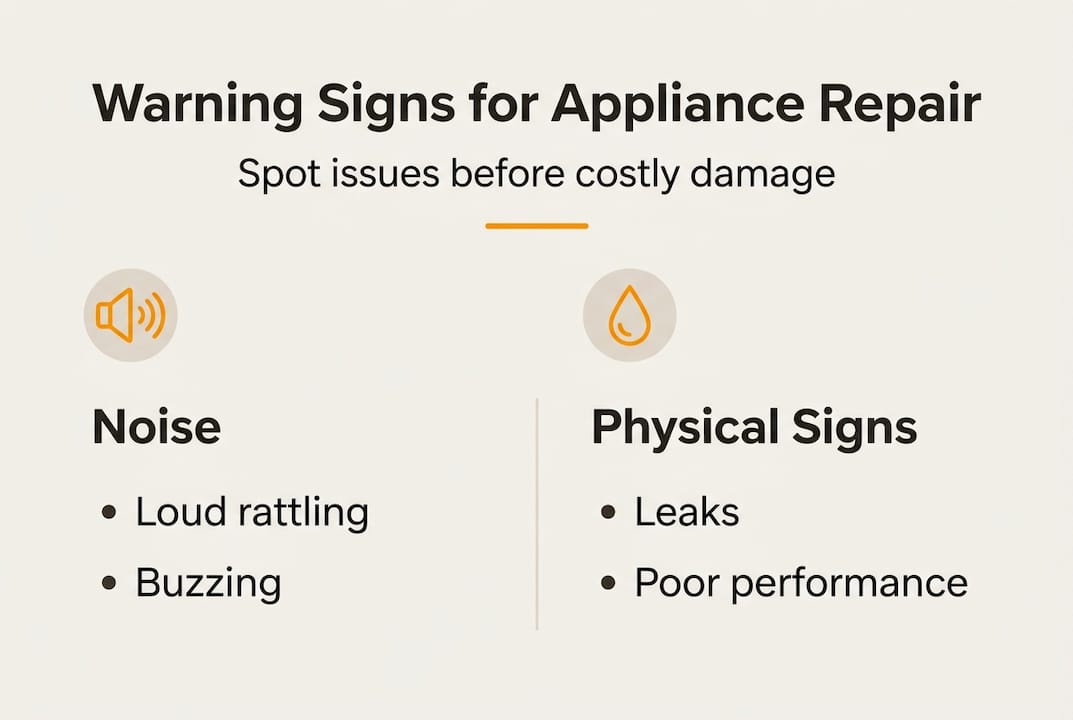
Leaks are another sign that demands immediate attention. Whether water is pooling beneath your washing machine or your dishwasher is leaving moisture on the kitchen floor, leaks can cause structural damage to your property if left unaddressed. In a London flat or terraced house, where properties are often in close proximity to neighbours, water damage carries additional risk and potential liability.
Electrical faults, such as appliances tripping your fuse board, flickering displays, or units that fail to power on consistently, should never be treated as minor matters. Gas appliances, in particular, must always be assessed by a qualified professional, as attempting any form of DIY intervention on a gas cooker or boiler carries serious safety implications.
Beyond safety, there is also the question of performance. An appliance that is technically operational but no longer performing as expected, such as a fridge that is not maintaining temperature or a tumble dryer that takes twice as long to dry a load, is likely consuming more energy and may be on the verge of a more significant failure.
“Professionals not only resolve the immediate fault but also identify underlying issues that could cause future disruption, and they provide guarantees that DIY repairs simply cannot match.”
As noted in guidance on appliance repair decisions, DIY is appropriate only for simple tasks such as cleaning coils or replacing filters, whereas more complex faults necessitate professional diagnostics. For a broader overview of what professional intervention involves, the appliance repairs guide offers useful context for London homeowners.
Pro Tip: Keep a brief log of any unusual behaviour your appliances exhibit, including the date and what you observed. This information is invaluable to an engineer and can significantly reduce diagnostic time.
When you can fix it yourself (and when you shouldn’t)
Distinguishing when a quick fix is possible from when it is time to step back is essential. Not every appliance issue requires a professional visit, and there are several straightforward tasks that most homeowners can safely carry out themselves.
The following are generally considered safe for a competent homeowner to address without professional assistance:
- Cleaning or replacing a washing machine filter to resolve drainage issues.
- Wiping down fridge condenser coils to improve cooling efficiency.
- Replacing a fridge interior lightbulb with the correct specification.
- Descaling a dishwasher or kettle using a proprietary descaling product.
- Checking and resetting a tripped circuit breaker after an appliance fault.
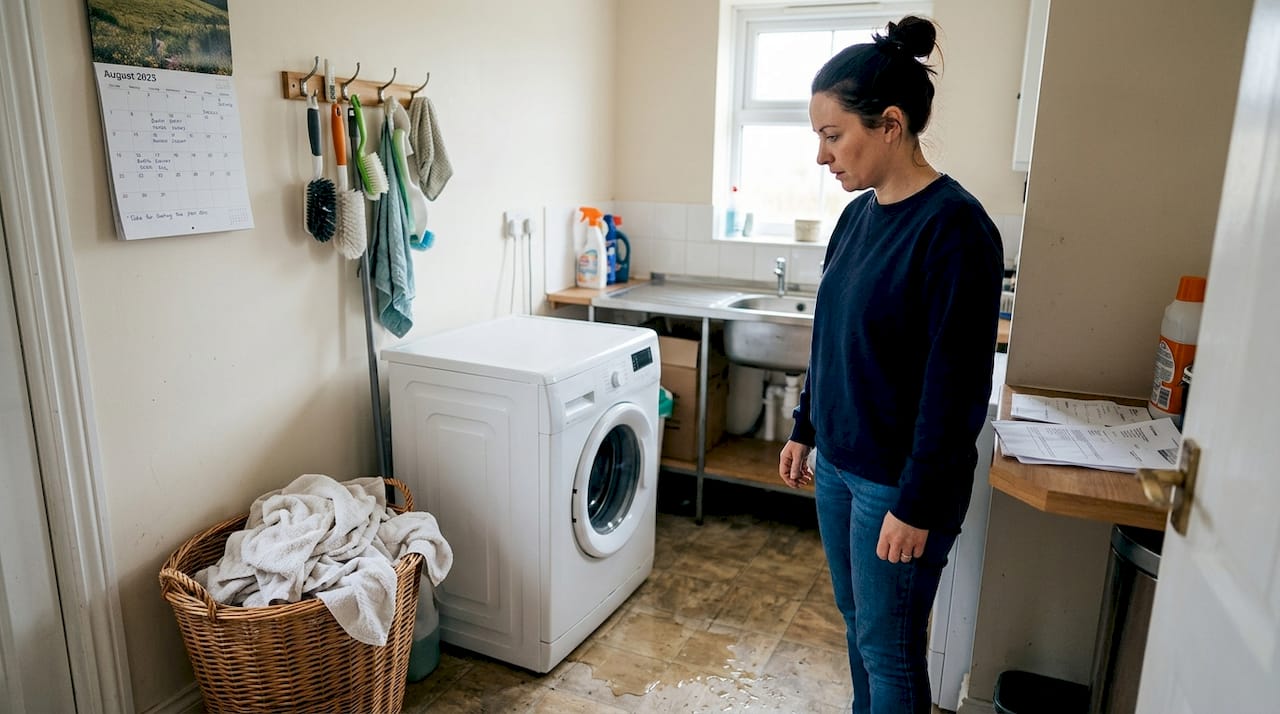
However, there are clear boundaries beyond which DIY intervention becomes inadvisable. If you encounter water leaking from internal components, persistent electrical faults, burning smells, or any issue involving gas connections, you should stop and contact a qualified engineer immediately. Attempting to resolve these issues without the appropriate training and equipment risks personal injury, property damage, and potential voiding of your appliance warranty.
Warranty considerations are particularly important. Many manufacturers specify in their terms and conditions that repairs carried out by unqualified individuals will invalidate the warranty, leaving you without recourse should the appliance fail again. Before attempting any repair, it is worth reviewing your appliance documentation or contacting the manufacturer directly.
For those in rented properties across London, the position is clear. Tenants are responsible for reporting faults promptly, whereas the responsibility for arranging and funding repairs to supplied appliances rests with the landlord. Attempting repairs yourself in a rented property could create complications regarding liability and damage deposits.
When assessing whether to proceed independently or seek professional help, it is worth considering the questions to ask before hiring home services to ensure you are engaging a suitably qualified individual. Guidance on choosing appliance repair professionals can also assist you in making a well-informed decision.
Pro Tip: If you are ever uncertain about the safety of a repair, err on the side of caution. The cost of a professional call-out is invariably less than the cost of rectifying damage caused by an unsuccessful DIY attempt.
Repair versus replace: making the best choice
Knowing the boundaries of DIY, your next step is deciding whether repair or replacement represents the wisest investment. This is a decision that many London homeowners find genuinely difficult, particularly given the emotional attachment that can develop towards appliances that have served a household reliably for years.
A useful starting point is to consider the age of the appliance relative to its expected lifespan. According to kitchen appliance lifespan data, typical lifespans are approximately ten years for a fridge-freezer, nine to ten years for a washing machine or dishwasher, and fifteen years for a cooker. If your appliance is approaching or has exceeded these figures, replacement may be the more prudent course of action.
The widely accepted rule of thumb is straightforward: if the cost of repair is less than 50% of the cost of a comparable new appliance and the unit is not yet near the end of its expected lifespan, repair is generally the better option. Conversely, if repair costs are high relative to the replacement price, investing in a new appliance is likely more economical in the long term.
| Appliance | Average lifespan | Repair if cost is under |
|---|---|---|
| Fridge-freezer | 10 years | 50% of replacement cost |
| Washing machine | 9 to 10 years | 50% of replacement cost |
| Dishwasher | 9 to 10 years | 50% of replacement cost |
| Cooker | 15 years | 50% of replacement cost |
It is also worth noting that UK homeowners frequently replace rather than repair broken appliances, partly due to the capacity constraints within the repair market. This tendency, however, is not always the most cost-effective or sustainable choice, particularly for appliances that are relatively young and have a fault that is straightforward to resolve.
Sustainability is an increasingly relevant consideration. Repairing an appliance rather than discarding it reduces waste and the environmental impact associated with manufacturing a replacement. For a more structured framework on this decision, guidance on repair vs replace decision-making offers a useful analogy from the property sector that translates well to household appliances.
Key factors to weigh when deciding:
- The age of the appliance relative to its expected lifespan.
- The repair cost as a proportion of the replacement cost.
- The availability of spare parts for older models.
- The energy efficiency of the existing appliance compared to a modern equivalent.
Selecting a trusted professional: what to check in London
Once you have decided that repair is the appropriate course of action, choosing the right professional is crucial. London’s repair market is broad, and the quality of service can vary considerably between providers. Knowing what to look for will help you engage an engineer who is both competent and trustworthy.
Certification is the first consideration. For gas appliances, the engineer must hold a valid Gas Safe registration, and you are entitled to ask to see their Gas Safe ID card before any work commences. For electrical appliances, look for engineers who are members of recognised trade bodies and carry appropriate public liability insurance.
Reviews and references are equally important. In London, where word of mouth carries significant weight, checking Google reviews, Trustpilot ratings, or asking neighbours in areas such as Canary Wharf, Wapping, or Islington for personal recommendations can provide reassurance about the quality of a service.
According to appliance repair service guidance, certified and insured engineers who offer warranties on their work and demonstrate transparent pricing are the benchmark for a reputable service. Vague or verbal-only quotes, reluctance to provide credentials, and poor communication prior to the appointment are all red flags that warrant caution.
| What to check | Why it matters |
|---|---|
| Gas Safe registration | Mandatory for all gas appliance work |
| Public liability insurance | Protects your property during the repair |
| Written warranty on repairs | Ensures accountability if the fault recurs |
| Transparent, itemised pricing | Prevents unexpected charges after the work |
| Verifiable customer reviews | Indicates consistent service quality |
Response time is another practical consideration, particularly if the fault affects an essential appliance such as a fridge or washing machine. Reputable services offering quality appliance repair in London should be able to provide a clear timeframe for attendance and keep you informed of any changes. Staying informed on home repair trends can also help you understand what to expect from modern repair services.
Pro Tip: Always request a written quote before authorising any repair work. A reputable engineer will have no hesitation in providing this, and it gives you a clear basis for comparison if you are obtaining multiple estimates.
Our take: why early professional help pays off
Conventional wisdom among many homeowners is to wait and see whether an appliance fault resolves itself or worsens to the point of complete failure before calling anyone. In our experience working across London properties, this approach almost invariably results in higher costs, greater disruption, and, in some cases, safety incidents that could have been avoided entirely.
The reality is that experienced engineers frequently identify secondary issues during a routine repair visit, issues that the homeowner was entirely unaware of and that, if left unaddressed, would have caused a further breakdown within months. The value of that diagnostic insight is difficult to quantify but genuinely significant.
There is also the matter of professional guarantees. When a qualified engineer carries out a repair, you have recourse if the fault recurs within the warranty period. That assurance is simply not available when a homeowner attempts a repair independently and the outcome is uncertain. Acting early, before a fault becomes critical, is the approach that consistently yields the best outcome for London homeowners, both financially and in terms of household safety and peace of mind.
Book trusted appliance experts in London
Ready to take the guesswork out of appliance breakdowns? Whether you have noticed an early warning sign or are dealing with a fault that has already disrupted your household routine, engaging a qualified professional promptly is the most practical step you can take.
Through find a certified London repair engineer, you can access fast, qualified engineers who offer transparent pricing, verified credentials, and warranties on all work carried out. Professional help not only resolves the immediate fault but also prevents the expensive surprises that come with delayed intervention. Getting your home back to normal, with the confidence that the repair has been carried out correctly, is precisely what a reputable London appliance repair service is designed to deliver.
Frequently asked questions
Is it worth repairing an old appliance?
If the repair costs less than half the price of a new appliance and the unit is not near the end of its typical lifespan, it is generally worth repairing rather than replacing.
Can a tenant arrange appliance repairs themselves?
Tenants should report faults to their landlord promptly, as landlords are responsible for repairing appliances that were supplied as part of the tenancy agreement.
How do I choose a safe appliance engineer?
Select a certified, insured engineer with verifiable customer reviews, a written warranty on repairs, and, for gas appliances, a valid Gas Safe registration card.
What is the risk if I delay calling a professional?
Ignoring minor faults frequently leads to more costly repairs, potential safety hazards, and in some cases the need for a full appliance replacement that could have been avoided with earlier intervention.
Recommended
Recent Post

ELSERVE Joins Which? Trusted Traders
2026-09-30 15:29:14

How to fix a slow spin cycle in your washing machine
2026-09-20 03:37:36

Appliance repair call-out fee: what London homeowners pay
2026-09-07 09:04:41
 Looking for a fast and reliable appliance repair service?




ELSERVE is a registered company in England. Registered number 09798443. VAT number 407675383
Some images used on this website are stock photographs used for illustrative purposes only and may not depict ELSERVE employees, customers, or actual service visits


-
ELSERVE Joins Which? Trusted Traders
2026-09-30 15:29:14
-
How to fix a slow spin cycle in your washing machine
2026-09-20 03:37:36
-
Appliance repair call-out fee: what London homeowners pay
2026-09-07 09:04:41