
Why a Fridge Defrosts Poorly: Causes and What to Do
2026-11-28 01:46:19
A fridge that defrosts poorly is usually suffering from one of two things: moisture is entering the cabinet faster than the appliance can clear it, or a part of the defrost system, such as the heater, the sensor, the timer or the control board, has stopped doing its job. The first group can often be checked at home in a few minutes, whereas the second needs an engineer who can test each component. In London, our engineers at Elserve diagnose fridges, freezers, fridge freezers and American style fridges on site, with same-day or next-day appointments in two-hour slots.
TL;DR
- Frost forms when warm, humid air meets the cold interior, so a poor door seal, a door left ajar or warm food in the freezer are the first things to rule out.
- A blocked defrost drain lets meltwater pool and refreeze, which often shows as a sheet of ice on the floor of the freezer.
- If ice returns after a manual defrost, a failed heater, sensor, timer or control board is the likely cause, and it needs diagnosis by an engineer.
- Do not use a hair dryer or sharp tools to speed things up, and leave electrical and cooling circuit repairs to trained professionals.
- Our diagnostic starts from £42 and our repairs carry a six-month service guarantee.
Table of Contents
- What a fridge defrost cycle is meant to do
- The signs that a defrost system is struggling
- Causes that come from outside the defrost system
- Causes inside the defrost system
- Safe checks you can make at home
- When to stop and arrange a repair
- How we diagnose and repair a poor defrost in London
- Our perspective
- FAQ
- Sources
What a fridge defrost cycle is meant to do
A modern frost-free fridge freezer cools by passing air over a very cold component called the evaporator, which is usually hidden behind a panel at the back of the freezer or fridge compartment. Moisture in the air condenses on it as frost, and that is entirely normal. To stop the frost building into a solid block, the appliance periodically switches off cooling and warms the evaporator briefly, so the frost melts and the water runs away.
Manufacturers describe this in similar terms. LG states that its refrigerators defrost automatically every 4 to 16 hours, and Bosch explains in its user manual that the back panel defrosts automatically, with the condensation running through a channel into a drainage hole and then to an evaporation pan, where it disperses. In many designs the sequence is controlled by a timer or control board, a heater that warms the evaporator and a thermostat or sensor that ends the cycle once the coils are warm enough.
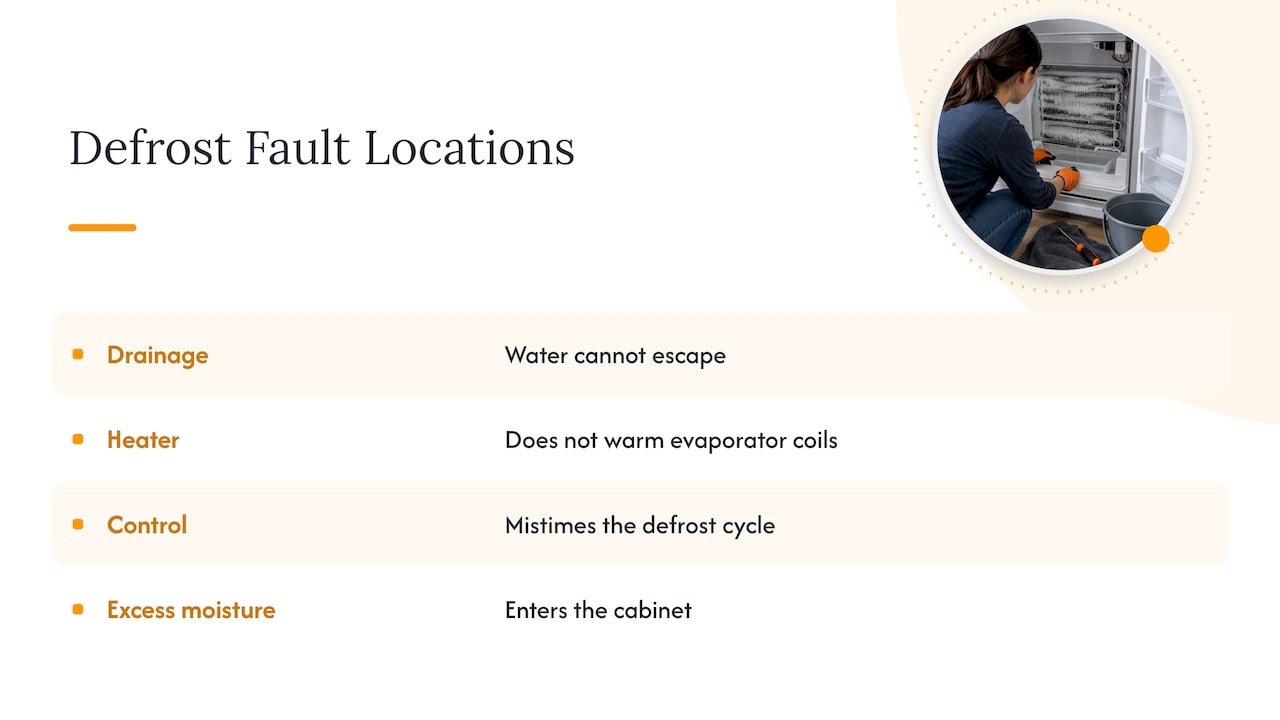
The practical consequence is that a defrost problem can start in four different places: the water cannot escape, the heater does not warm the coils, the control does not start or stop the cycle at the right time, or the cabinet is taking in more moisture than the system can manage. Identifying which one applies is the entire purpose of diagnosis.
The signs that a defrost system is struggling
The symptoms are fairly consistent across brands, although they can be misleading, because a fridge that is warm is often assumed to have a failing compressor when the actual cause is ice blocking the airflow.
The most common signs are heavy frost on the back wall of the freezer, ice forming on the floor of the compartment, water pooling beneath the vegetable drawers or inside the fridge, a fridge section that is warm while the freezer remains cold, and a rattling or humming fan struggling against ice. A failed defrost sensor can produce heavy frost, a warm fridge section with a still-cold freezer, reduced airflow, temperature fluctuations, error codes and frost that returns after a manual defrost, although that same source stresses that the sensor is only one possible cause and the whole system must be considered before any part is replaced.
Some appliances also show a code. LG, for example, explains that an F dH or r dH error indicates a defrosting failure, attributable to ice accumulation, a blocked drainage hole, a disconnected temperature fuse or heater, or a main circuit board failure, and that it appears when normal compartment temperature is not detected after defrosting has begun. Other brands use different codes, so the manual for your model is the right reference for what a displayed code means.
Causes that come from outside the defrost system
Before any component is blamed, it is worth establishing whether the cabinet is simply admitting too much moist air. This is the largest and cheapest group of causes, and it is the one a householder can reasonably examine.
Door seals and door habits
Samsung explains that frost is caused by warm, moist air getting inside and freezing, and it suggests opening the door for less than a minute at a time and letting hot items cool before they are stored. A door that does not close fully has the same effect continuously. This can happen because a shelf or a drawer is overfilled, because the appliance is not level, or because the gasket around the door has hardened, split or come away from its groove.
Ideal Home reports an appliance specialist recommending a simple paper test: close the door on a sheet of paper, and if it slides out easily, the seal may need replacing. The same article lists frequent door openings, faulty seals, incorrect temperature settings, poor ventilation, warm or uncovered food and a clogged defrost drain among the usual reasons for ice in a freezer. A worn seal also makes the appliance work harder, which is a reason to deal with it promptly rather than simply scraping away the frost.
Warm food, uncovered containers and blocked vents
Steam from a hot casserole, or moisture evaporating from an open container, becomes frost within hours. Covering food and allowing it to cool first reduces the load on the defrost system considerably. Vents inside the cabinet, which circulate cold air, should also be left clear, since Samsung notes that blocked vents can trap moisture and an overpacked compartment can prevent the door from sealing.
A thermostat that over-cools
A thermostat that keeps the appliance running when it should cycle off will increase frost formation. Ideal Home carries expert comment that a malfunctioning thermostat can keep cooling the freezer unnecessarily, causing excessive ice build-up. If the settings are correct and the seals are sound but the ice persists, the fault is more likely to lie inside the appliance.
Causes inside the defrost system
When the door seal passes the paper test and the food habits are sound, the cause is usually one of the following.
A blocked defrost drain
Meltwater leaves the evaporator through a small drain. If food particles or ice block it, the water has nowhere to go, so it spreads across the compartment floor and freezes. LG notes that a sheet of ice on the freezer floor after a manual defrost indicates a blocked drain line that requires a professional. Where the manufacturer permits it, light cleaning of the channel is part of routine care: Bosch’s manual advises cleaning the channel and drainage hole regularly, for example with a moistened cotton bud, and Beko’s manual describes clearing the tube with the supplied plunger and flushing with about 100 ml of warm water, warning that excessive water will overflow the tray and cause a leak.
A failed defrost heater
The heater is the part that actually melts the frost. If it burns out or its wiring is disconnected, the evaporator ices over progressively, airflow falls and the fridge compartment warms even though the freezer may still feel cold. Testing it involves electrical measurement behind a panel, which is not a task for a householder.
A faulty defrost sensor or thermostat
The sensor or termination thermostat tells the control when to stop heating. ACHR News explains that a faulty control can either fail to start a defrost cycle or end it too quickly, and that a temperature switch stuck closed can cause a cycle to terminate immediately. A sensor reading outside its expected resistance range leads to either replacing the sensor itself or the control board, as a Whirlpool service manual describes for its defrost sensor error procedure. The same trade source warns against leaving a termination switch disconnected, since the evaporator can then be over-defrosted. These are the reasons why parts should be tested rather than guessed at.
A defective timer or control board
Older models use a mechanical timer, while newer ones rely on an electronic board that decides when defrosting is needed. If either fails, defrosting may happen rarely or not at all. Because several different faults produce the same frosting pattern, replacing a part without testing is a common and costly mistake.
Safe checks you can make at home
The aim of home checks is to remove the simple causes and to give the engineer useful information, never to open the appliance. The following sequence is consistent with manufacturer guidance.
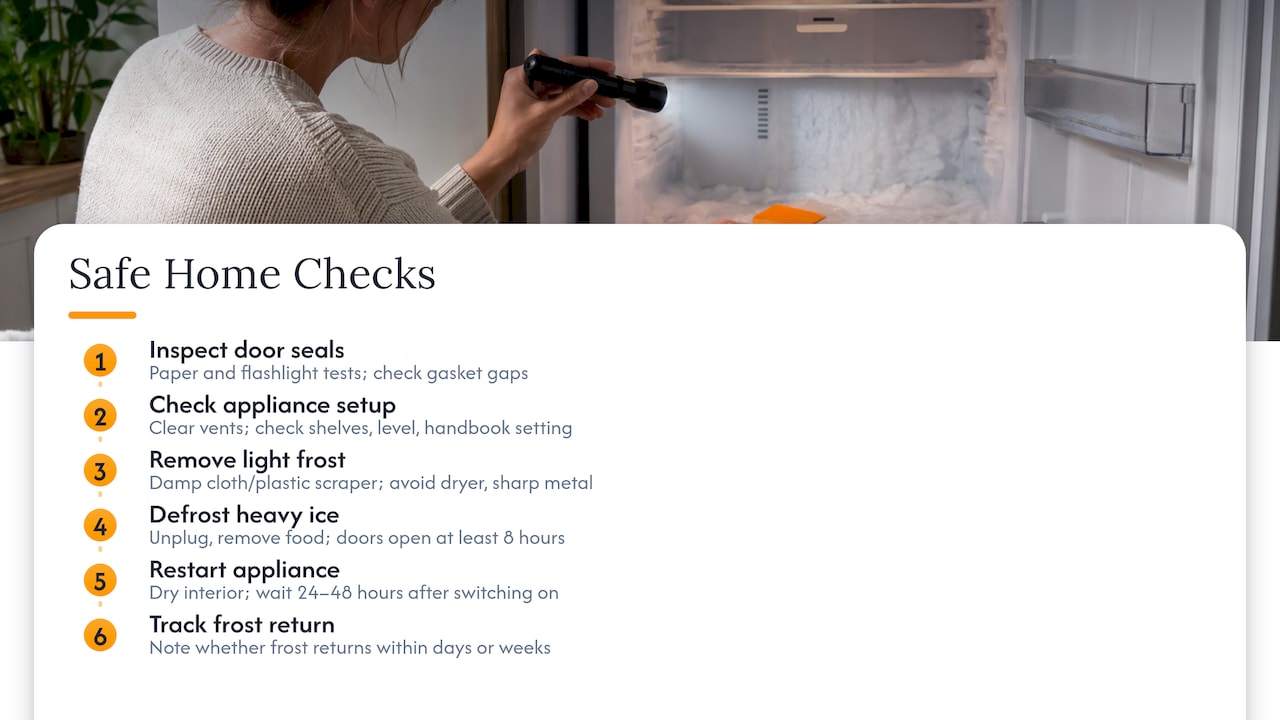
First, examine the door seals, run the paper test around all four sides, and check for gaps where the gasket has lifted. Samsung suggests a flashlight test: place a torch inside, close the door and look for light escaping, as that marks where the door is not closing properly.
Second, check that nothing is protruding from the shelves, that the vents are clear, that the appliance is level and that the temperature setting matches the manufacturer’s recommendation in the handbook.
Third, if the amount of frost is light, wipe it with a damp cloth or remove it with a plastic scraper. Samsung cautions against using a hair dryer to speed defrosting, because it can damage the refrigerator, and sharp metal tools risk puncturing the evaporator, which is a serious and expensive fault.
Fourth, if the ice is heavy, a full manual defrost is reasonable. LG’s procedure is to unplug the unit, remove the food, leave the doors open for at least eight hours with towels to catch water, dry the interior and then wait 24 to 48 hours after switching on for normal operation. Frozen food should be kept cold in the meantime, so a cool box or a neighbour’s freezer is advisable for a long defrost.
Finally, take note of how long it takes for the frost to return. If the ice is back within days or weeks, the manual defrost has treated the symptom rather than the cause.
When to stop and arrange a repair
A manual defrost is a reset, not a repair. If a defrost heater, sensor or timer has failed, the evaporator will ice up again no matter how carefully the door is managed, and the fault must be traced to the specific component. Manufacturers draw the same line. LG states that a repeated defrost error after the ice has melted needs a service technician for an accurate diagnosis, and for a blocked freezer drainage hole its guidance is to unplug the unit and leave the door open for a day in summer or three days in winter before reassessing.
Beko’s manual is more explicit about the boundary: repairs to the compressor, cooling circuit, main board, inverter board or display board must go to authorised professional repairers, and attempts outside the permitted maintenance list may cause fire, flood, electrocution or serious personal injury. Electrolux’s UK manual similarly states that non-professional repairs can have safety consequences and may affect the guarantee.
In practical terms, you should book an engineer if any of the following applies: ice returns after a manual defrost, the fridge compartment is warm while the freezer is cold, water is pooling inside or beneath the appliance, an error code repeats, or the seal is torn or split.
How we diagnose and repair a poor defrost in London
We repair fridges, freezers, fridge freezers, American style fridges and wine coolers across London. Appointments are offered as same-day or next-day visits in two-hour slots, at no extra charge for the speed, so a household with a warm fridge and a freezer full of food is not left waiting for a week.
Our engineers carry out on-the-spot diagnostics, which matters for defrost faults because the same frost pattern can come from a drain, a heater, a sensor or a board. Our engineers have access to manufacturer databases, and they are DBS checked, which is reassuring when someone is working in your kitchen. The diagnostic is priced from £42 as a one-off, and our pricing is fixed rather than open-ended. Every repair carries a six-month service guarantee, with ongoing expert aftercare.
If your fridge is icing up, you can book a repair appointment with Elserve and tell us the make, the symptoms and any error code on the display.
Our perspective
Most of the frozen-up fridges we are asked about have been defrosted by hand at least once before the owner calls. The ice melted, the fridge worked for a few days, and then the problem returned. That pattern tells us something useful: the cabinet was not the problem, and the defrost system itself is no longer doing its work.
The temptation at that stage is to replace whichever part sounds most plausible, usually the sensor or the board. Our view is that a defrost fault should be diagnosed, not guessed, because the heater, the sensor, the timer and the drain can all produce the same symptoms. That is why we put the diagnosis first, at a fixed price from £42, and why our engineers use manufacturer database information to identify the correct component for your model.
We would also encourage you to deal with the matter early. A fridge compartment that runs warm puts food at risk, and an appliance that works against heavy ice is under unnecessary strain. A same-day or next-day visit, with the repair covered by a six-month service guarantee, is designed to remove the uncertainty for the household.
Victor
FAQ
Can defrosting a fridge manually fix the problem?
It clears the ice and will often restore normal cooling for a time, which is useful when the cause was a door left open or a poor seal. If the frost returns within days or weeks, a component such as the heater, sensor or timer has probably failed, and an engineer needs to diagnose which one.
Why did my fridge freeze up?
The usual reasons are warm, humid air entering through a poor seal or frequent door openings, a blocked drain that lets meltwater refreeze, or a defrost part that has stopped working. Checking the seals with the paper test is the quickest first step, and persistent icing points to a fault that needs a visit.
What happens if the defrost sensor fails?
The control board can no longer judge when to start or stop defrosting, so heavy frost may build on the evaporator, airflow falls and the fridge section warms while the freezer stays cold. Because other parts produce the same signs, the sensor should be tested before it is replaced.
How do I make my fridge less cold?
If the fridge is too cold, check the temperature dial against the setting recommended in your handbook, and make sure food is not pressed against the back wall. If the cabinet keeps over-cooling and ice forms despite correct settings, the thermostat may be at fault and should be checked by an engineer.
Can I use a hair dryer to speed up defrosting?
No. Samsung warns that a hair dryer can damage the refrigerator, and combining water, heat and mains electricity in a kitchen carries its own risks. Unplug the appliance, protect the floor with towels and allow the ice to melt naturally.
Sources
- LG: Troubleshooting an F dH or r dH error
- LG: Refrigerator frost buildup
- Samsung: Frost forms in the freezer or refrigerator
- Bosch: KIV86/87 user manual
- Beko: No-frost refrigerator freezer user manual
- Electrolux UK: LNT6TE18S5 user manual
- Ideal Home: Why is ice building up in my freezer?
- ACHR News: Troubleshooting defrost timers
- Whirlpool service manual FM4BM30IFBI
- AppliancePartsGroup: Appliance defrost sensors
Recent Post

Why a Fridge Defrosts Poorly: Causes and What to Do
2026-11-28 01:46:19

Rust Remover for a Washing Machine: What Is Safe to Use
2026-11-26 21:05:58

Dishwasher Air Dry: How It Works and Why Dishes Stay Wet
2026-11-26 20:42:33
 Looking for a fast and reliable appliance repair service?




ELSERVE is a registered company in England. Registered number 09798443. VAT number 407675383
Some images used on this website are stock photographs used for illustrative purposes only and may not depict ELSERVE employees, customers, or actual service visits



-
Why a Fridge Defrosts Poorly: Causes and What to Do
2026-11-28 01:46:19
-
Rust Remover for a Washing Machine: What Is Safe to Use
2026-11-26 21:05:58
-
Dishwasher Air Dry: How It Works and Why Dishes Stay Wet
2026-11-26 20:42:33